Flu Complication Warning Signs


We've recently explored some 268 Flu Tactics in our fight against the flu. The post (268 Flu Tactics) explored various ways we all can keep the flu virus at bay, as well as care for ourselves as much as we can by using mostly lifestyle modifications, to protect ourselves and those around us.

In this post, I would like to explore complications of the flu virus and those persons in our populations who are at high risk for those complications. The flu in adult on average lasts between 3 to 7 days, however in some people it can extend up to 10 days.

Usually the flu runs its course and resolves within the time mentioned above, however there are times where its symptoms hangs on, rebounds or even worsens. It is therefore very important for each Wadadlian to know warning signs of a worsening viral flu infection and its possible complications.

Flu Complication Warning Signs

  • Flu symptoms that improve then return with a high fever and worsened symptoms such as increased cough, aches, chills, headaches, fatigue.
  • Fever greater than 37.6 degrees Celsius or 99 degrees Fahrenheit
  • Chest pain or pressure
  • Abdominal pain
  • Shortness of breath or difficulty breathing
  • Severe Vomiting or Diarrhoea
  • Seizures
  • Fainting spells
If during the progress of a flu infection you or a loved one experiences this, it is time to get help and consult your nearest healthcare provider.


Complicated flu infections can progress to illnesses such as pneumonia, muscle inflammation (rhabdomyolysis), meningitis among many others. Please do not ignore your body's cry for help.

Now we know what warning signs to look out for, what about knowing which persons in our community that are at high risk for developing Flu Complications?

Persons at High Risk for Flu Complications

  • 6 month old babies and older children up to 5 years
  • Adults 65 years old and over
  • Pregnant Women
  • New mothers (up to 2 months after birth)
  • Nursing home residents
Persons who suffer from certain medical conditions are also at risk:
  • Persons with the following medical conditions:
  1. Cancer
  2. AIDS/HIV
  3. Diabetes Mellitus
  4. Sickle Cell Disease
  5. Persons who use a regular treatment regimen of steroids
  6. Epilepsy, stroke and other neurological conditions
  7. Kidney Disease
  8. Asthma
  9. Obstructive lung disease
  10. Weight disorders (extreme obesity or anorexic states)

Kindly take these elements into consideration if you or a loved one becomes infected with the flu virus. Remember to review the 268 Flu Tactics but if warning signs appear, do not wait, go to your healthcare provider immediately.


Wishing you all the best, and much blessings
#wadadlianstrong

© 2018


268 Flu Season Tactics


The flu season is upon us...some of us are reading this in bed with body aches, chills, runny noses, eyes, and temperatures. Some of us are worrying about loved ones who just don't seem to be able to get through it, while others of us are sending love to family member and friends... from a distance, trying to show we care but still informing them that though its all love we've been there, done that and aren't keen on experiencing this particular rollercoaster willingly if we can avoid it.

What is the Flu Virus?


The flu or influenza virus that is made up of 3 strains. They are known simply as A, B, and C (rare type). This viral infection targets the body's respiratory system.


The influenza A and B virus are usually in rotation around the winter and autumn months in temperate countries, though some tropical areas may experience their effects all year round.

In recent times one of the most popular strains of influenza A is the H1N1( swine flu), whose warning banners you will encounter throughout the airports of our region. The A virus has other subtypes such as H3N2, and H5N1 (avian flu), among various others.

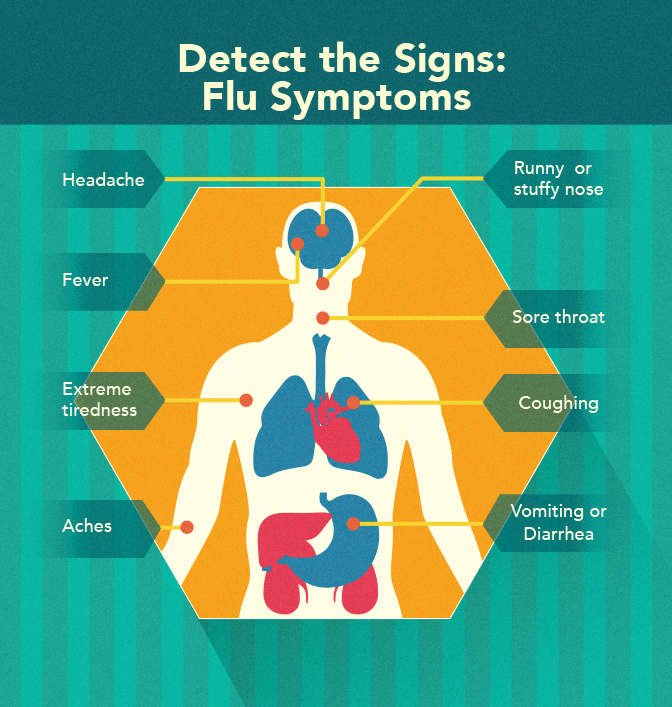
Most, if not all of us know what symptoms we experience when infected with the flu virus, but here's a summary:

https://www.fix.com/assets/content/15511/detect-flu-symptoms.png
Courtesy www.fix.com

Now we have an idea of what the flu virus is, and how it affects us, let's have a look at tactics we all can use to help reduce our risk of flu infection.

268 Flu Season Tactics

  • Those of us perceived as insensitive for staying away are actually on to something. Less contact with infected persons will obviously mean reduced risk of infection. As a result, if possible this is a relevant plan of action.


If you are caring for someone at home who has the flu be sure not to share eating utensils, and dishes without washing them carefully first. Keep their personal items separate in the home.

Try your best to also disinfect surfaces that are often touched by your sick loved one.


Courtesy www.webmd.com

  • Wash your hands often with soap and water for at least 20 seconds. If you are not able to at least have on hand an alcohol based hand sanitizer. Be sure your hands are clean before and after meals, in public areas and restrooms, after touching possibly contaminated surface.
  • Avoid touching your face. This is the easiest way to contaminate yourself with the virus.
  • Exercise. Exercise actually helps to raise the level of your immune system and ward off infection.
  • Health Eating Habits. Remember food is fuel, you can either use it to help your body by boosting your immune system or harm it by feeding it empty calories. Eating a nutritious, balanced diet is key.
  • Keep hydrated. Water aids the body in resisting infection.
  • Keep your stress levels in check. Stress can weaken your immune system, thus making you more vulnerable to infection. 

But what if you are already infected?

Well, here are some rules for you

For those of us who are sick or have children who are sick...and know it...sharing in this case is not equivalent to caring.
  • Kindly. Stay at home. Kindly. Stay away from work or school if you are sick. Kindly. Keep your child or children isolated from other children as much as you can.  This is not only to ensure the efficiency of  body's healing process, but for the good of others in our community. This is caring in action.The flu can be spread via droplets in the air one day before symptoms show, and up to 5 to 7 days after symptoms come about.
  • When coughing or sneezing cover your nose and mouth with a tissue. You should also sneeze or cough into your arm as opposed to your hand. Remember also to dispose of your used tissue paper.
  • Drink lots of fluids, to prevent dehydration. Preferably water and vitamin C rich liquids.
  • Eat easy to digest meals, like warm chicken soups, or vegetable broths.
  • REST. Give your body time to overcome the process.
  • Keep fever medication on hand and a trusty thermometer.
  • If you feel unsure how to handle your symptoms, or if you feel that you or a loved one is getting worse, consult your health care provider immediately.
Most of these suggestion are based on lifestyle modifications, as in Antigua & Barbuda many Wadadlians choose to let the viral illness run its course with symptomatic care, however, when doing so please keep these rules in mind, especially the last one, as the flu like any other illness can have complications.


I hope this gave you some perspective about the flu. If you want to read about how your body warns you your flu may be becoming complication,  check out this post on Flu Complication Warning Signs. Meanwhile stay safe and stay #wadadlianstrong.

Blessings to you and yours.

© 2018

Barbuda Devastation Relief Efforts


On the 22nd Anniversary of Hurricane Luis, Hurricane Irma ravaged our sister island Barbuda, leaving many homeless, and destroying government infrastructure.


courtesy ABS Television
As a result efforts are ongoing to provide ways for Wadadlians home and abroad , and all other persons who feel led, to provide support in renewing our sister isle, and supporting our Barbudan family. Please share this post!


Provided below are trusted sources where financial contributions can be made:

1. Antigua Commercial Bank (ACB)

   
    Account Name: Barbuda Relief and Rebuilding Fund
   Account Number: 100004717


2. Caribbean Union Bank (CUB)


    Account Name: Barbuda Relief and Rebuilding Fund
   Account Number: 10001372


3. The ticketing app on behalf of Antigua & Barbuda Red Cross

Download The ticketing app here: https://ticketingevents.co/
Track contributions here: https://ticketingevents.co/helpbarbuda/

While financial contributions will definitely go a long way in reconstructing Barbuda, particular supplies are needed both critically and urgently to aid our displaced brothers and sisters. These are the following:


Non-cash donations can be remitted through the following:

The Multipurpose Cultural and Exhibition Centre,
Perry Bay, St. Johns, Antigua 
Contact Telephone: (1- 268) 464-5056
                                                736-3419 /20/21/23

,
Antigua & Barbuda Red Cross Society,
P.O. Box 727,
Old Parham Road,
St. Johns, Antigua
Contact Telephone: (1- 268) 462-0800

National Office of Disaster Services (NODS)
P.O. Box 1399
American Road,
St. Johns, Antigua

Contact Telephone: (Intl) (1- 268) 562-2144

                                                          460-7075

                                   (Local)           462-4206           


Its time to mobilize our nation.
stay # wadadlianstrong


Dealing with Diabetes. Part III. Symptoms and Signs of Type 2 Diabetes.

Now that you've become acquainted with Type 2 Diabetes Risk Factors in the last post, let's move on to symptoms....


How would you suspect that someone you know may be suffering from diabetes?
Could you have diabetes type 2?


DIABETES TYPE 2 SYMPTOMS AND SIGNS


Excessive Hunger

Read this carefully...
courtesy youtube.com


Insulin's role is to help the sugar get into our body's cells.
The problem is when you suffer from diabetes there is less than usual, or very little.

Quite literally, you are eating food, but despite it being converted to sugar in the body, your cells can't access it, because there is no insulin to help the sugar inside the body's cells.

The body realizing that it's not receiving any food, and hence no energy, very wisely, will trigger your "hunger sensation" to inform you. 'Listen I need to be fed!!'

So you eat...and you eat,  and you do realise that you are eating more than usual.  
However, the more you eat, still, the hungrier you are, the more your body screams out "I need food!!"

courtesy fivehourdiabetic.com


The caveat is that your sugar level is rising as a result.
The food and energy your body's cells so desperately need is inside you but because there isn't enough insulin, the cells of your body can't access it in for energy.

Its an unfortunate cycle.


Unintended Weight Loss

 courtesy substance.com

In our communities this is usually the first thing you'll hear a villager comment on,

" So and so drap weight so quick me min deya say he/she mussa hab shugah, yuh know dah dey suck yuh dry..."

It does....not exactly in those terms, but you see, the body has to look for an alternative route for energy. I've already explained excessive hunger, we can piggy back off of that explanation.

Despite eating the cells of the body are unable to take in and use sugar due to a lowered amount of insulin, or a lack thereof in the blood.

Weight loss occurs because since the body (despite your best efforts to feed it) cannot get the energy it needs from sugar,  it wisely looks for alternatives.. "Ok, seems as if this human isn't feeding me, let me use something else to get some energy!"

Where does it look to? Fat and muscle. By burning those, the body get some of the energy it requires to keep itself going.

As a result however, all we see is that "so and so" is dropping weight all of a sudden.


Excessive Thirst

Thus the domino effect continues.


So far you have an idea that the excess amount of sugar in the blood is to be blamed for the symptoms. How does that translate into excessive thirst?

Let's get closer to home first. Bear with me.
Think of the black pineapple.


courtesy wes.com


Yes. The Black Pineapple. Trust that I'm going somewhere with this.

Antigua and Barbuda is notoriously drought ridden. The dry conditions of our climate, have been blamed for the concentrated sugary sweetness that is the Antigua black, more rain water according to older villagers would have produced a less sweeter pineapple.

How does this relate to you being thirsty more than usual?

More sugar in the pineapple, less rainwater in the pineapple. More sugar in blood, means less fluid in the blood.  As a result, to wisely compensate, the body now recruits fluid from out of the cells to dilute the sugar that's in the blood. It has to find a way to restore balance.

Can you imagine the predicament of the body's cells?

First, no sugar, no energy. This is despite the body generating hunger pangs to help give them what they need desperately. That was a failed mission, so they had to turn to the muscle and fat for help. Now on top of all that, it seems they now have to send out the fluid inside them into the blood stream because there is too much of the sugar (that they need!) on the outside. 

Imagine that jack.

Now there's a new cry. "Human, I'm dry!! Give me fluid!!"

courtesy www.healthcentral.com


...and thus begins the story of your excessive thirst.

As more fluid is pulled out of the body's cells to compensate for the high sugar on the outside, the thirstier you become, for the louder the body cries for fluid.

Fluid may even be recruited from the lenses of the eyes. This can result in another symptom. Blurred Vision.


Frequent Urination

Of course, the more fluid that you drink, the more you will urinate.

courtesy freemalaysiatoday.com

Also, urine may have a sweet odour.
This is because the kidney aren't able to re-absorb all the sugar out of the urine.


Slow healing cuts and/sores

You will notice that cuts and sores will take an abnormally longer amount of time to heal. This is because the high sugar content and decreased uptake of insulin contributes to a decrease in the body's cell response to tissue injury.

courtesy www.healthtap.com


Frequent infections

As a result of the high sugar levels, cells in  the immune system will not function as they ought.   
Our immune system is in charge of fighting disease and infections. If this barrier malfunctions this means the body is more open to infection.

Some persons may have frequent urinary tract infection, thrush, genital yeast infections, or recurrent skin infections.


If you or a loved one has any of these symptoms or signs with associated risk factors be sure to see your primary care physician.

I hope that this helped someone understand  diabetes a bit better.
Till next time, blessings to you and yours.

Stay #wadadlianstrong

©June 2016

Dealing with Diabetes. Part II. Risk Factors. Type II DM


In the last post we focused on the classification of Diabetes. 
Today we'll talk about risk factors that may predispose you to suffering from this common disease.
Let's focus on Diabetes Type II.
Risk factors for Diabetes Type II can be split into two parts. Risk factors that you can change, and those that you can't. First up, those you can't change, otherwise known as Non-Modifiable Risk Factors

NON-MODIFIABLE RISK FACTORS

These are the risk factors you have no power over. These include:

  • Race - Person of African, Asian, Pacific Islander, Hispanic and Native American descent are more likely to suffer from DM type II


  • Family History - if you have relatives that suffer from diabetes, this increases your risk.

  • History of Gestational Diabetes - females who were diagnosed with diabetes during pregnancy are at an increased risk for diabetes mellitus type II.


There are other risk factors however, that may be evident in your life currently, that you can change, these are known as:

MODIFIABLE RISK FACTORS


  • Sedentary Lifestyle
  • Obesity -  being overweight makes your body's cell less receptive to the effects of insulin.

  • Unhealthy Diet


  • Smoking

courtesy quitsmokingcommunity.org


    Other modifiable risk factors include, high cholesterol levels, as well as high blood pressure levels.


    There you have it. Risk Factors of Type 2 Diabetes.

    http://www.diabetes.org/are-you-at-risk/diabetes-risk-test/
    How at risk are you? Here's a risk test from the American Diabetes Association.


    Be sure to take it and to share it. Don't take your risk for shugah lightly.


    Have you read the first post of this series on "Shugah" ? If not click here.
    Next up Symptoms of Type 2 Diabetes Mellitus...See you soon
    Stay #wadadlianstrong
    Blessings to you and yours,


    ©June 2016



Pancreas and its Hormones. Sugar Control.


Have you ever wondered about what this "insulin thing" everyone talks about, in reference to Diabetes is?
Many of you may think of medication, when you hear insulin...which is good, because it is an important medication used to control diabetes; however, it is so much more...

Insulin is one of many important hormones in our body, it helps to regulate blood sugar levels and is made in an organ known as the pancreas.

What is the Pancreas?


This is a flat organ located near the small intestine that measures around 12 x 15cm. It might interest you to know it has a head, a body and a tail.


The pancreas is made up of different types of cells that secrete various hormones, we'll be focusing on two of these hormones today in order to understand how the pancreas helps to control your sugar.

  • The A Cells/Alpha cells of the pancreas secrete a hormone called Glucagon.


  • The B Cells/Beta cells of the pancreas secrete the hormone Insulin.


Think of the pancreas as a control centre, its (A)Alpha and (B) Beta cells go into action, when the sugar levels in your body is too low or too high. 

 GLUCAGON, INSULIN AND SUGAR CONTROL


 Let's consider how glucagon, the alpha/a cell hormone functions.


When your blood sugar is low, the pancreas begins to secrete glucagon from its alpha/a cells.

This state of low blood sugar is known as hypoglycaemia (hypo=under) (glyc=sweet)  (aemia=blood).
 Literally, undersweet blood. Imagine that, eh? :)

Back to Glucagon.

After being secreted glucagon's job is to go to another organ in the body, that we associate with alcohol...the liver.

Glucagon helps the liver to make glucose and release it into the bloodstream, as this happens the blood sugar level rises.

When the sugar level in the blood is high enough, this triggers glucagon to halt its work.

The takeaway point?  

Glucagon is a hormone that is secreted by the A/Alpha cells of the pancreas that raises blood sugar when it is low.


But what about the ever popular insulin?
Well insulin, as mentioned earlier is secreted by the beta/b cells of the pancreas, goes into action when your sugar level becomes too high. This state of high blood sugar is known as hyperglycaemia .

Tell me, if hypoglycaemia is undersweet blood, what do you think hyperglycaemia is?

Hyperglycaemia  is made up of (hyper=over), (glyc=sweet), (aemia=blood). Oversweet blood. Hyperglycaemia is just a more complex word to say this.

Let's talk about how insulin functions.

 
 Your blood sugar is high, and the beta/b cells of the pancreas start to secrete insulin.

The simple version is that insulin's job is to act on your body's cells helping them to increase their absorption of the excess sugar that is in your blood stream.

Once inside your body's cells, glucose is made into more complex substances for storage.

With glucose entering the cells, and being stored, your blood sugar level's fall.
When low enough, insulin's work is halted .

 Of course if the sugar level falls too low, glucagon is released once more to do its part.

The takeaway point?  

Insulin is a hormone released by the Beta/B cells of the pancreas that lowers the blood sugar when it is high.


This, my dears is how the pancreas controls your sugar through its hormones, insulin and glucagon.
Do you know how Diabetes is defined? Click here to find out more...

Remember to share the information you learn with your loved ones, and friends.
Visit our official facebook page and show some love with a thumbs up.
Blessings to you and yours.


©November 2015


Dealing with Diabetes. Part I. Definition. Classification.

Today we will start a series on Diabetes, better known to Antiguans & Barbudans as simply Shugah
These topics coincide with November being the month for Diabetes awareness.


First of all, do you understand what is meant by diabetes?

When you go to the hospital or visit your doctor you may hear the term Diabetes Mellitus.
Here's a super short history:


I'll just let that last line sink in for a moment...

courtesy www.lewisliveshere.com


Definition of Diabetes Mellitus

Diabetes Mellitus is a term representative of a range of symptoms and signs that stem from an increased level of sugar in the blood; this high sugar content is caused by either a total depletion of the body's insulin, or a significant decrease of the body's insulin compared to what is considered normal.

A mouthful really, but now you know what shugah really is in its simplest form.
Let's learn a bit about how its classified.
The bare essentials of course.

Diabetes Mellitus can come about under different circumstances in different people.
Here is a brief overview of a classification based on three groups.
  • The Primary Group
  • The Other (Specific Types)Group
  • The Gestational Group
 

PRIMARY

 This is one of, if not the most popular groups that many people know about. Maybe not particularly grouped like this, but by its parts. The primary group is made up of:
  1. Type 1 Diabetes Mellitus or Insulin Dependent Diabetes Mellitus
  2. Type 2 Diabetes Mellitus or Non-Insulin Dependent Diabetes Mellitus
N.B.
Diabetes Mellitus type 1 is also known as Juvenile Diabetes, since it usually is found in young adults and children. 

 OTHER

 This group basically encloses many other factors that directly cause Diabetes Mellitus. Examples of these are the following:


  • Certain medications,for example corticosteroids.
  • Pancreatic Diseases
  • Increase of the body's production of hormones that influence a decrease in insulin production.
  • Certain Genetic Syndromes, for example Down's Syndrome.

Last but not least, another group that is well known to Wadadlian's would be the...

GESTATIONAL

courtesy  www.about.com


 During pregnancy there is a vast amount hormonal changes occur, for some women, they become less responsive to insulin, and this causes an increase in blood sugar that can either end after their baby is born or continue on throughout their lives.


 courtesy healthline.com

There you have it. Diabetes Mellitus defined and classified. 
If you are interested in learning about how your body controls the sugar levels in the blood, click here.
Next up you'll learn about the symptoms and signs.
Stay #wadadlianstrong
Blessings to you and yours,


©November 2015